Web development
Accessibility, SEO and AI: why clear HTML is easier for engines to understand

Accessibility · Semantic HTML · SEO · AI
An accessible page is not magically better ranked. It is mainly less ambiguous for systems that must read it without seeing it.
- Structure Headings, landmarks, links, labels and DOM order carry meaning.
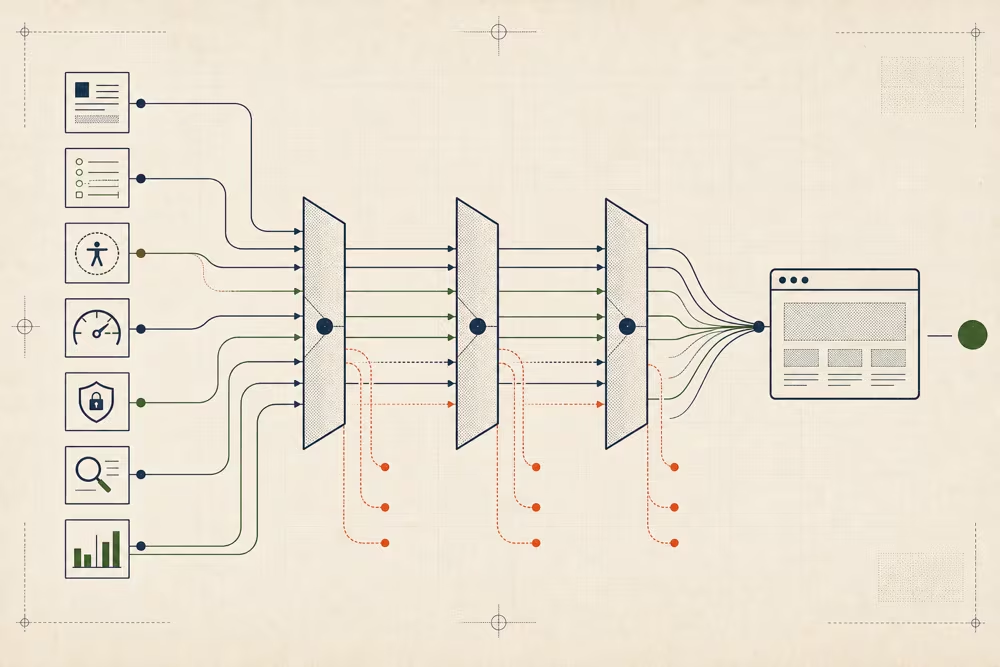
- Parsing Screen readers, crawlers and assistants rely on similar structural clues.
- Limit This is neither a ranking promise nor a guaranteed AI citation.
- Bridge GEO deals with citability; this page deals with structural readability.
Checked on July 1, 2026. RGAA 4.1.2 remains the official French reference, RGAA 5 has been announced for late 2026, WCAG 2.2 is the stable W3C recommendation, and the EAA applies from June 28, 2025 to covered products and services.
Short answer
Accessibility, SEO and AI meet on one point: a clear page leaves less room for interpretation.
A web page is not only read on a screen. It is parsed by a browser, a screen reader, a search engine, an audit tool, a structured-data parser and sometimes an AI assistant trying to understand what the page says, what it allows a user to do and which entities it connects.
Accessibility is therefore not a bonus separated from digital performance. It forces the page to make its structure explicit: a real title, ordered subheadings, understandable links, named buttons, fields connected to their labels, useful image alternatives, readable data tables, a declared language and a DOM order that still carries meaning.
This work does not replace SEO strategy, GEO methodology or citable content. It prepares the foundation. The cleaner the structure, the less a non-human system has to guess what is important, actionable or secondary.
An accessible page is first a page that is more reliable to interpret. It is a clarity advantage, not an automatic visibility promise.
Essential framing
What accessibility does not promise for SEO and AI.
Avoid the tempting shortcut: "making a page accessible necessarily improves Google ranking" or "an accessible page will be cited more often by ChatGPT". That would be too simple, and therefore dangerous. Google does not rank a page only because its labels are correct. An AI assistant does not cite a source only because its HTML is clean.
The real effect is more subtle: accessibility reduces structural ambiguity. It helps machines separate main content from decoration, an action from a visual element, a heading from enlarged text, a useful link from "click here", a required field from an optional field, or a data table from a layout table.
"Accessibility guarantees better ranking."
"Accessibility makes the page more robust to read, audit and interpret."
"ARIA and semantic HTML replace GEO strategy."
"A clear structure complements citable content and structured data."
Same page, four readings
A human, a screen reader, a crawler and an assistant do not see the same thing.
Visual design can compensate for many weaknesses for a sighted user: size, color, proximity, icon, animation and position. But those clues disappear or become secondary when a system reads the DOM, extracts headings, announces an interface or summarizes a page. This is where accessibility becomes a discipline of precision.
| Reader | What it uses | What misleads it | Signal to secure |
|---|---|---|---|
| Sighted user | Visual hierarchy, colors, spacing, sizes, positions and microcopy. | A beautiful but vague interface, actions that look alike, discreet errors. | Visible labels, clear path, explicit feedback. |
| Screen reader | Accessibility tree, roles, accessible names, focus order, headings and landmarks. | Unnamed buttons, fake headings, vague links, unmanaged modals. | Name, role, value, visible focus, Hn structure. |
| Crawler | Rendered HTML, links, headings, main content, canonical, robots rules and structured data. | Late content, non-descriptive links, confused architecture, orphan pages. | Stable DOM, internal links, editorial hierarchy, indexability. |
| AI assistant | Extractable text, sections, entities, context, sources, evidence and sometimes search results. | Generic content, implicit relationships, disconnected proof, blocks that cannot stand alone. | Clear structure, autonomous answers, sources, coherent data. |
Structural grid
The 9 signals that make a page easier to understand.
These signals are not an RGAA certification and they are not a complete WCAG checklist. They form a layer of structural readability: the minimum needed for an assisted human, a search engine and an extraction system to understand the page without rebuilding its meaning from fragile visual clues.
Reference
A page title, H1 and H2s that stay coherent.
The browser title, the H1 and the subheadings should tell the same story, without artificial stuffing or decorative Hn tags.
Landmarks
Main content and identifiable regions.
A main, navigation, footer and named regions prevent content, decoration and interface from being mixed together.
Links
Links that describe their destination.
A link such as "read the RGAA, WCAG and EAA guide" gives context. Repeated "learn more" links force the reader to guess.
Actions
Buttons named after their real action.
A button should announce what it does: send, open, close, filter, download, compare. The icon alone is not enough.
Images
Alternatives that carry information, not the file name.
An informative image should explain what it adds. A decorative image should be safely ignored.
Forms
Fields connected to labels, help text and errors.
The prospect should never have to guess what is requested, what is required or how to fix an error.
Data
Tables reserved for real data.
When a table contains a comparison or results, its headers should let each cell be understood outside the visual layout.
Language
A declared language and explicit language changes.
Language affects pronunciation, assistive technologies, lexical interpretation and sometimes extraction.
DOM
An HTML order that remains logical without layout.
If the page loses meaning when read in DOM order, the design is hiding a structural weakness.
Demonstration
The same block can look good to the eye and be poor for machines.
The example below looks ordinary: a service card with a visual title, an icon and a request field. Yet the weak version turns meaning into appearance. The strong version makes relationships explicit.
The title is styled text, the button has no name, and the field has no exploitable label.
<div class="card" onclick="location.href='/audit'">
  <div class="big">Accessibility audit</div>
  <img src="/icon-check.svg">
  <input placeholder="Your email">
  <button><svg>...</svg></button>
</div>The title, link, decorative image, label and action can all be understood explicitly.
<article aria-labelledby="accessibility-audit-title">
  <h3 id="accessibility-audit-title">Accessibility audit</h3>
  <img src="/icon-check.svg" alt="" aria-hidden="true">
  <p>Identify keyboard, form and HTML structure blockers.</p>
  <label for="audit-email">Work email</label>
  <input id="audit-email" name="email" type="email" autocomplete="email">
  <button type="submit">Request the audit</button>
  <a href="/audit/accessibility">See the accessibility audit method</a>
</article>The second version does not only give more information to a screen reader. It also reduces ambiguity for automated audits, crawling, extraction and quality control.
Tools
Lighthouse, WAVE, validators and AI only see part of the problem.
Automated tools are essential for industrializing checks, but they cannot judge the whole experience. They can detect an unnamed button; they cannot always say whether the chosen name actually helps the user. They can report a missing label; they do not prove that the error message lets the user finish the form.
This is why a useful audit combines at least four layers: automated rules, DOM review, keyboard testing and real journey testing. The point is not to replace humans with tools. It is to give each tool the right role.
Edikka method
The 20-minute structural readability test.
This test does not replace a full RGAA or WCAG audit. It quickly shows whether an important page is clear enough to be understood by several non-visual readers: a screen reader, crawler, audit tool, assistant or internal parser.
| Check | Question | Expected proof | Risk if it fails |
|---|---|---|---|
| Hn structure | Do the H1 and H2s describe the page without relying on design? | Readable outline from the table of contents or inspector. | Main topic or sections poorly identified. |
| Landmarks | Is the main content identifiable? | One main and named regions where useful. | Navigation, content and secondary elements get mixed together. |
| Links | Do links keep their meaning outside context? | Descriptive anchors and coherent destinations. | Weak internal linking, confused action, imprecise extraction. |
| Actions | Does each button announce its action? | Visible or computed accessible name. | Components become unusable or misinterpreted. |
| Forms | Are fields, help text and errors connected? | label, aria-describedby, precise errors, confirmation. | Lost enquiries and poor data quality. |
| Accessibility tree | Do headings, links and buttons appear named? | Browser inspection or screen reader test. | The visual DOM does not match assisted reading. |
| Structured data | Does JSON-LD describe visible content without contradiction? | Types, entities and links aligned with the page. | Incoherent graphs and loss of semantic trust. |
Anti-cannibalization
This page does not replace GEO: it prepares the HTML layer that GEO can use.
The mistake would be to turn this article into a guide on "how to be cited by ChatGPT". That is not its role. Citability in AI answers also depends on autonomous answer blocks, sources, dates, evidence, entities, internal links, reputation and repetition across corpora. That topic belongs to the dedicated SEO and GEO pages.
Here, the subject is lower level: is the page structured enough for its content, actions and relationships not to be guessed? In other words, before asking whether the page deserves to be cited, check that it can be read cleanly.
Priorities
The roadmap to become a reference: prove, connect, then publish.
For a French company, accessibility should not remain a legal page. It can become proof of method: the ability to publish a status, document a scope, acknowledge limits, fix journeys, connect SEO and AI issues without mixing them, then make the method verifiable.
Publish proof
Declaration, report, scope, criteria, limits and dates should be visible, not hidden in a forgotten PDF.
Connect clusters
Accessibility, web development, SEO, GEO and conversion should answer each other without cannibalizing each other.
Test journeys
Keyboard, forms, reflow, JavaScript components, accessibility tree and key content should be verified on real pages.
Maintain over time
A page that works today can break tomorrow. Reference status is built through repeated checks.
Conclusion
Structural clarity is the common ground between accessibility, engines and assistants.
A confusing page can remain usable for someone who sees the design, knows your habits and guesses the intent. It becomes much more fragile when read by a screen reader, crawler, validator or assistant that reconstructs meaning from HTML.
This is why accessibility is strategic: it forces the site to say explicitly what it is, what it contains, what matters and what the user can do. This clarity serves people. It also serves every system that reads your page without looking at it.
Before trying to be cited, ranked or recommended, make your pages impossible to misunderstand.
Edikka vision
The web that is readable by everyone becomes the web that is readable by systems.
Reference status is not built by promising magical SEO effects. It is built by showing, page by page, how meaning is made explicit.
Reduce effort
A clear journey requires less memory, less precision and less deduction.
Reduce ambiguity
Explicit HTML gives systems stable reference points instead of fragile visual clues.
Document the method
Credibility comes from scope, tests, dates, limits and visible corrections.
Go further on this topic
Additional answers to clarify the key points covered in this article.