SEO
Website redesign: what redirects preserve — and what they do not guarantee
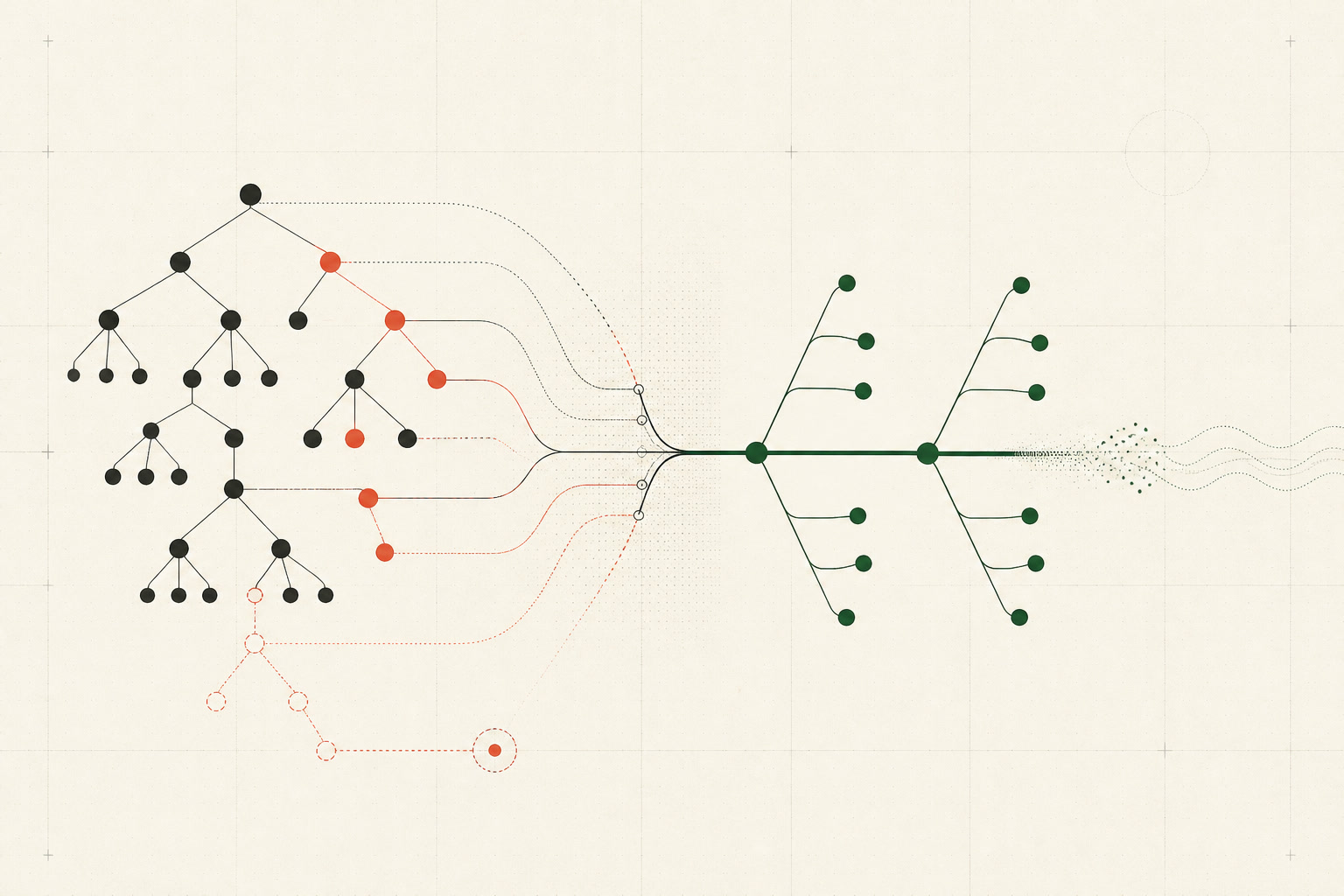
A website redesign can retain every redirect and still lose visibility. This happens when new pages no longer contain the answers, evidence, links or access conditions that made the old website useful.
This protocol separates what a migration can genuinely preserve, what it can only support and what no agency can guarantee in Google or AI-generated answers.
Short answer
A successful migration preserves more than URLs. It protects answers, evidence and the conditions that make them discoverable.
During a website redesign, a permanent redirect tells visitors and search engines that a resource has moved. It helps them reach the new destination. It does not guarantee that a Google ranking will remain stable, that the new URL will be processed immediately or that a citation will carry over into an AI-generated answer.
A sound protocol therefore protects three separate layers: technical access, editorial substance and measurement. If one disappears, a redirect cannot recreate it.
This guide is for organizations redesigning a website that is already indexed, linked from other websites or used as a source. For the broader project framework, read Edikka’s method for avoiding costly website redesign mistakes.
A redirect preserves a route. It does not automatically preserve the value that used to sit at the destination.
State of knowledge
Before acting, separate what is established, what is useful and what no migration can guarantee.
AI visibility attracts many recommendations that cannot be verified. A migration should not be driven by assumptions presented as rules. The table below defines the evidence standard used throughout this guide.
| Evidence level | What can be retained | Project consequence |
|---|---|---|
| Established | Permanent redirects, canonicals, internal links, sitemaps and indexability help search engines discover and interpret moved content. | Test them before and after launch. |
| Established · gradual availability | Google Search Console documents a generative-feature inclusion control and a report covering impressions and pages exposed in AI Overviews and AI Mode. Both interfaces are still rolling out to a subset of properties. | Check inherited settings and export a baseline when the interfaces are available. |
| Useful, not guaranteed | Clear content, retained evidence and structured data that matches the visible page can make the new resource easier to understand. | Preserve meaning, not only the address. |
| Service-specific | OpenAI asks publishers not to block OAI-SearchBot if they want content to be discoverable and cited in ChatGPT Search. | Test robots.txt, the firewall, the CDN and the final HTTP response with the correct user-agent. |
| Not demonstrated | No public documentation guarantees that an AI citation will transfer from an old URL to a new one. | Measure whether cited pages reappear instead of promising that they will. |
Preserve means retaining the technical and editorial conditions required for rediscovery. The decision to index, rank or cite a page always belongs to the relevant search engine or answer system.
Google states that keeping the same site architecture at the new location helps signals transfer more directly. By contrast, combining a domain move with redesigned content and a new URL structure is likely to cause traffic loss because pages must be reinterpreted and reassessed individually. When possible, separate the technical move from the structural redesign. When that is impossible, document the risk, prioritize critical URLs and never present the mapping as a guarantee of neutrality.
Before the redesign
Build a reference state before the old website disappears.
Losses are difficult to diagnose when nobody retained the initial state. The inventory must be completed before the editorial freeze and before any DNS switch. It should not be limited to URLs listed in the sitemap: a page that still receives visits, links or citations may no longer appear there.
Inventory
Merge URLs from crawls, sitemaps, analytics and webmaster tools.
Each source uncovers pages that the others may miss.
Value
Identify pages that generate impressions, visits, links, inquiries or downloads.
Low overall traffic can hide a page that is decisive for a highly qualified intent.
Substance
Retain titles, answers, evidence, authors, dates and useful outbound links.
These elements make a page specific and independently verifiable.
Discovery
Record canonicals, indexability, click depth and major inbound links.
An accessible but isolated URL does not send the same signal as a page at the center of the architecture.
AI visibility
Export available AI surfaces and freeze an observation corpus.
The Google generative report when available, Bing AI Performance, available cited pages and clicks carrying utm_source=chatgpt.com should be dated and accompanied by their limitations.
In Google Search’s generative report, the “Pages” dimension uses the final URL after redirects and assigns most data to the canonical URL. Export the page-level view before launch, then manually connect old and new URLs through the matrix. Otherwise, the old URL disappears from the report precisely when it becomes necessary to compare it.
URL-by-URL decisions
An old URL should not automatically receive a redirect.
The right question is not “where should this URL redirect?” but “is the same intent still served elsewhere?”. An unrelated destination disappoints the user and may be interpreted as a soft 404. Google specifically recommends avoiding mass redirects to an irrelevant destination such as the home page.
| Situation | Decision | Expected check |
|---|---|---|
| Same content, new address | Use a direct permanent redirect to the new URL. | A 301 or 308 response with no chain or loop. |
| Several pages merged | Consolidate into a page that genuinely covers their intents. | Distinctive information and useful evidence are retained. |
| Page kept unchanged | Keep the URL when changing it provides no clear benefit. | Self-referencing canonical, consistent content and internal linking. |
| Content removed with no equivalent | Return a genuine 404 or 410 response. | No misleading redirect to the home page or a vague category. |
| Generated, filtered or duplicate URL | Treat the cause: canonical, crawl control, removal or correction of the URL generator. | The source of duplication disappears, not only the observed URL. |
| Old URL | Decision | Destination | Retained check |
|---|---|---|---|
/old-service | Direct 301 | /new-service | Same intent, dated client evidence retained, final 200 response and query parameters preserved. |
/advice-a | Consolidate | /complete-guide | The specific answer, sources and useful links from the old page are genuinely retained at the destination. |
/finished-operation | 410, no redirect | None | No relevant equivalent exists; the page redirects neither to the home page nor to a generic category. |
Redirecting everything to the home page, creating old → intermediate → final chains, or sending a valuable page to a destination that retains neither its answer nor its evidence.
Beyond 301 redirects
Preserve the units of information that people and systems came to find.
A redesign can retain every redirect and still lose what matters. This happens when the new design shortens the copy, removes authors, turns tables into images, drops sources or merges precise pages into one generic commercial page.
For each priority page, acceptance testing should compare the old and new versions across five dimensions: the intent served, the main answer, the evidence, the named entities and the links that allow verification to continue. The presentation may change. The informational function should not disappear by accident.
Structured data must remain consistent with visible content. It can support processing and eligibility for rich results, but it is not an AI citation switch. Google states that no special Schema.org markup is required for its generative features.
If someone arriving through the old URL can no longer find the answer, evidence or action they expected, the migration is incomplete even when the HTTP status is correct.
Search and answer engines
AI visibility starts with public, accessible and discoverable content — not a magic file.
For Google Search’s generative features, the fundamentals remain those of Search: crawling, indexing, eligibility for a snippet and useful content. Google also states that it does not use llms.txt and requires neither a Markdown version nor special markup for inclusion in generative answers.
Search Console now provides two distinct interfaces through a gradual rollout: an inclusion control covering AI Overviews, AI Mode and generative features in Discover, and a Search performance report limited to AI Overviews and AI Mode. Discover has its own report, while Search Labs experiments are excluded. Inclusion is the default setting. When the interface is available, however, check the parent property’s value and inheritance before and after launch. Changes usually take several days to propagate; Google says an exclusion generally takes effect one to two days after the control is deployed, sometimes longer because of caching and propagation. The report measures impressions and exposed pages. It does not explain why a page was selected.
An llms.txt file or Markdown version may be retained when it serves a documented use for the website or another service. It should not be presented as a Google visibility factor. During a redesign, preserving it is maintenance of an existing public resource, not a citation guarantee.
For ChatGPT Search, OpenAI recommends not blocking OAI-SearchBot. Testing should cover the complete delivery chain: robots.txt, noindex directives, CDN, web application firewall, anti-bot protection, JavaScript challenges and the final HTTP response. OpenAI also adds utm_source=chatgpt.com to reference URLs. This parameter measures identifiable clicks, not citations without a click or delayed influence. For the underlying access decisions, read Edikka’s guide to AI crawlers.
A page blocked from crawling may still have its link and title displayed in ChatGPT Atlas if the URL is discovered elsewhere. OpenAI recommends noindex when that display is not wanted, while noting that the crawler must be able to read the directive. Atlas also relies on ARIA roles and labels to interpret interfaces. Their continuity therefore belongs in functional acceptance testing, as explained in Edikka’s guide to agent-ready websites.
For Bing and its AI experiences, a clean sitemap and IndexNow can report added, changed or removed URLs more quickly. This can speed up discovery. It guarantees neither indexing nor citation.
Bing ignores changefreq and priority, but uses lastmod as a freshness signal. The value should reflect the content’s actual last modification in ISO 8601 format with date and time, not the time at which the sitemap was generated. A redesign does not justify assigning the same lastmod to every page: retain the previous date when the content has not changed and update it only when the page has genuinely changed.
Test the HTTP response actually served to OAI-SearchBot, then follow an old URL to its final destination. The second command should print the final status and the URL reached.
curl -sS -I -A "OAI-SearchBot" https://www.example.com/page

curl -sS -L -o /dev/null \
  -w "HTTP %{http_code} · %{url_effective}\n" \
https://www.example.com/old-serviceSyntax depends on the server. In both examples, the rule matches only the exact old path and points directly to the canonical destination.
# Apache · mod_alias, exact match
RedirectMatch permanent "^/old-service$" "https://www.example.com/new-service"

# Nginx
location = /old-service {
  return 301 https://www.example.com/new-service;
}A migration can preserve and accelerate the conditions for rediscovery. It cannot promise that an engine will cite the same page again, in the same place or within the same time frame.
Pre-launch acceptance testing
Launch should begin only when every critical check is repeatable.
| Check | Acceptance criterion | Trace to retain |
|---|---|---|
| Mapping | Every priority URL has an explicit, justified decision. | Versioned matrix, owner and approval date. |
| Redirects | The final destination responds correctly, with no loop or avoidable chain. | Export from the crawl of old URLs. |
| Indexability | Expected public pages no longer carry staging restrictions. | Robots, meta robots, headers and canonicals checked. |
| Content | Required answers, evidence, authors, dates and links are present in accessible HTML. | Comparison of priority pages. |
| Measurement | Analytics, consent, conversions and webmaster tools work as intended. | Dated tests and received events. |
| Sitemap and lastmod | The sitemap contains the expected canonical URLs and every lastmod reflects the actual content modification in ISO 8601 format with a timestamp. The launch date is not applied indiscriminately to every page. | Sitemap export, date source and a sample of changed and unchanged pages. |
| AI crawlers | The chosen policy is applied consistently through to the final server response. | HTTP responses by user-agent and published rules. |
| Google AI inclusion | When the control is available, the property and any parent property permit the intended inclusion in generative features. Any change accounts for propagation time. | Dated screenshot of the setting, inheritance, controlled property and any change date. |
| Domain change | When the entire site moves to another domain or subdomain, the Change of Address submission is planned after redirects are active. The tool is not used for a path-only change, HTTP to HTTPS or www to non-www on the same domain. | Exact scope of the move, 301 checks and decision on whether to use the tool. |
| Access and properties | The same Google account owns the source and destination properties, both available at domain level. A path-prefix property is not sufficient. | Owning account, verified properties and each property’s level. |
| Subdomain variants | For a domain change, every old-domain variant — apex, www, m, language or another subdomain, even one rarely used — is verified and handled separately. A request for the apex domain does not automatically move its subdomains. | Variant inventory, Search Console property and confirmation for each request. |
| Migration sequence | No immediate A→B followed by B→C move is planned. If several websites converge on one destination, move them one at a time after the previous site has stabilized. | Sequence, stabilisation criteria and launch decision for each wave. |
| ChatGPT attribution | A test URL carrying utm_source=chatgpt.com retains the parameter after redirection and reaches the authorized analytics property. | Final URL, received event and applied consent. |
After launch
Monitor the migration on day 1, day 7, day 30 and day 90 — then day 180 when the domain changes.
Google warns that a migration can cause temporary fluctuations and that a small or medium-sized site may take several weeks before most URLs have moved in the index. A drop the next day does not prove permanent failure. Overall stability does not prove that every critical page has migrated correctly either.
| Timing | Priority checks | Expected decision |
|---|---|---|
| Day 1 | HTTP statuses, redirects, robots, noindex, canonicals, sitemap, conversions and major pages. For a domain change, submit Change of Address for every verified source variant after checking the 301 redirects. Recheck the Google inclusion control when available. | Correct any global block or incorrect destination immediately, then retain every Change of Address confirmation where applicable. |
| Day 7 | Crawling, newly discovered URLs, old URLs still served, errors and orphan pages. If the Google inclusion setting changed, verify propagation without assuming that it is instant. | Repair mapping, internal linking or discovery for priority pages and document any propagation delay. |
| Day 30 | Impressions and pages in Google’s generative report when available, clicks carrying utm_source=chatgpt.com, Bing citations, landing pages and conversions. | Distinguish technical defects, content loss and changes in demand. |
| Day 90 | Comparison by page family and intent over equivalent time windows. | Document the outcome, limitations and second-wave optimization. |
| Day 180 · domain change | End of the relationship window declared through Change of Address, active redirects, residual traffic to the old domain, accessible old pages and domain renewal. | Keep redirects beyond 180 days when they still serve users, remove old pages that should no longer exist and retain the old domain for at least one year to reduce malicious re-registration risk. |
Search Console’s generative Search report measures impressions and exposed pages in AI Overviews and AI Mode. Discover has a separate report and Search Labs is not covered. The “Pages” dimension follows the final URL after redirects and generally assigns data to the canonical. A before-and-after comparison therefore requires a pre-migration export and reconciliation through the matrix. Bing Webmaster Tools exposes citations and cited pages across its AI experiences. The utm_source=chatgpt.com parameter identifies some outbound clicks from ChatGPT. None of these signals independently measures no-click influence or proves the cause of a change. For a complementary protocol, read Edikka’s method for measuring AI visibility.
Deliberate limitation
This protocol does not turn a documented practice into a promise of results.
At the publication date, Edikka does not attach a client before-and-after study that isolates the effect of a migration on AI citations. Available data does not yet support attributing the retention or loss of a citation to one technical action.
The article therefore relies on official documentation from Google, OpenAI and Microsoft, then separates repeatable checks from outcomes that cannot be guaranteed. A future client case will be added only when the baseline, dates, scope, metrics and publication permission support a verifiable reading.
We can guarantee a documented inventory, mapping, acceptance process and monitoring plan. We cannot guarantee a ranking or citation produced by a third-party system.
Primary sources
The rules and limitations used in this guide can be checked at their source.
- Google Search Central — site moves with URL changes.
- Google Search Console — Change of Address tool.
- Google Search Central — optimization for generative features.
- Google Search Console — inclusion control for generative features.
- Google Search Console — generative AI performance report.
- OpenAI — publishers and developers FAQ.
- Microsoft Bing — sitemaps, IndexNow and AI-powered search.
- Microsoft Bing — AI Performance in Bing Webmaster Tools.
Sources reviewed on 7 August 2026. Platform interfaces and recommendations can change; the date places this protocol in its proper context.
Conclusion
A strong redesign organises continuity before it pursues novelty.
Design, technology and content can change substantially without sacrificing what made the old website useful. That continuity is prepared URL by URL, evidence by evidence and measurement by measurement. It does not rest on a redirect list assembled the day before launch or on an impossible visibility guarantee.
Edikka’s website redesign method brings strategy, UX/UI, development and SEO/GEO into one scope. Migration is treated as a project deliverable with decisions, owners and acceptance criteria.
Edikka’s position
A responsible migration documents continuity. It does not sell the absence of risk.
Edikka connects every decision to a URL, an intent, a piece of evidence, an owner and a dated check. Success is not a global score: it is the absence of an untreated critical break.
Maintain meaning
A destination retains the intent, answer and useful evidence from the old page.
Test before launch
Every critical check has an expected result and a repeatable trace.
Observe without over-attributing
Changes are monitored over time and interpreted within stated limitations.
Go further on this topic
Additional answers to clarify the key points covered in this article.