SEO
29 out of 30 hotels have no explicit AI rule - 2026 GEO study
2026 GEO Study
29 out of 30 hotels have no explicit AI rule.
This is not an access problem. None of the tested sites blocks the main AI crawlers observed. It is a governance problem. The sites are open by default, but rarely managed explicitly for AI engines.
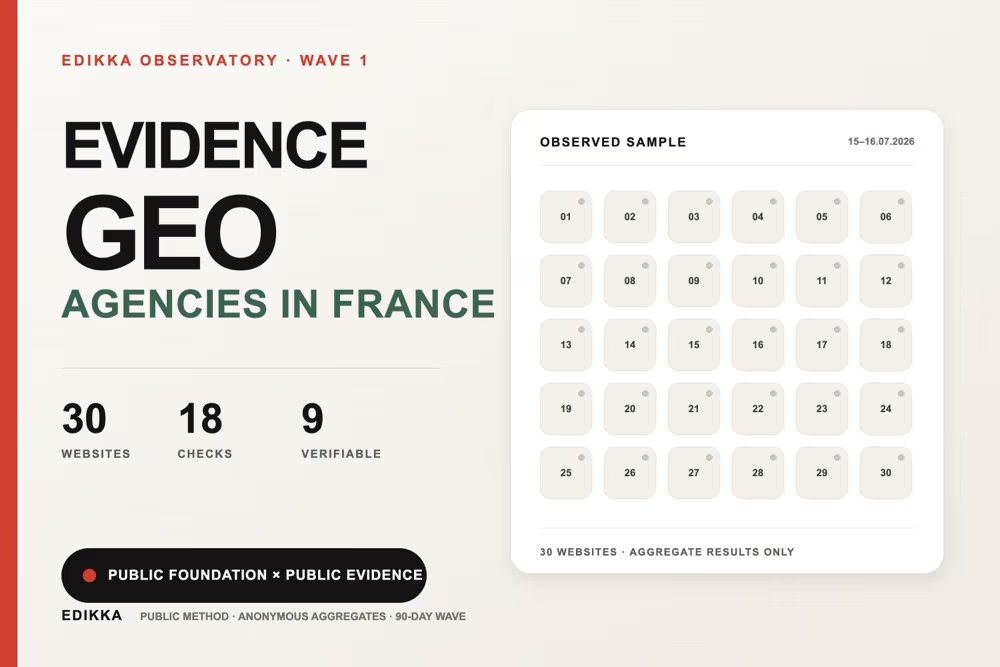
- N = 30 sites
- June 10, 2026 crawl date
- 76/100 average score
- 84/100 median score
With the Edikka GEO Readiness Index, this study shows where these websites are already readable by AI, and where they still need to become reliable, clear and citable sources for ChatGPT, Perplexity, Gemini or Google AI.
2026 finding
What the first Edikka GEO Readiness Index panel reveals.
29 out of 30 hotels have no explicit AI rule, despite an average score of 76/100.
Access remains open by default, but is almost never governed through an explicit AI rule.
Average GEO readiness score observed across the panel. The median score reaches 84/100.
No site in the panel blocks the main AI crawlers tested in its robots.txt file.
Only one site is in the weak range. 9/30 are emerging and 20/30 are advanced.
The result is more interesting than a simple alarmist headline. In this Paris-based panel, hotel websites are not massively invisible or technically broken. Many already have a solid foundation, with accessible pages, sitemaps, local information, room pages, service pages and useful content for travellers.
The issue sits elsewhere. Most sites are ready for classic web reading, but few formalise a clear AI governance strategy. They leave conversational engines and assistants to access information by default, without documenting access rules, entities, reference sources or formats designed for reliable reuse.
GEO readiness is not about blocking or forcing AI. It is about turning an already accessible website into a clearer, more governable and more reusable source.
Why measure it
AI visibility needs evidence, not just GEO talk.
Search is changing shape. A traveller no longer only types a short hotel query into a list of results. They may ask ChatGPT, Perplexity, Gemini or Google AI to compare options according to a precise context that includes district, train station, parking, spa, breakfast, atmosphere, direct booking, accessibility or proximity to a meeting place.
In these journeys, the challenge is not only to be indexed. It is to be understood, summarised and potentially cited in an answer. This shift does not make SEO obsolete: it makes SEO more demanding. A site still needs to be fast, crawlable and relevant, but it also needs to expose structured, consistent, factual information that can stand on its own without being distorted.
Edikka built the GEO Readiness Index to move beyond broad claims. The goal is not to predict with certainty which brands will be cited by AI systems. The goal is to measure observable conditions that make a website more or less usable in these environments.
The Edikka GEO Readiness Index is a score out of 100 that evaluates a website’s ability to be crawled, understood, contextualised and potentially cited by AI engines, based on public and verifiable signals.
It measures readiness, not a promise. A strong score does not guarantee a citation in ChatGPT, Perplexity, Gemini or Google AI. It indicates that the site exposes information that is more accessible, more consistent and easier to use.
Crawl
02AI robots
03Structured data
04Citable content
Methodology
A public, anonymised and reproducible panel.
The panel was built on June 10, 2026 from the public classified tourist accommodation in France dataset, published by Atout France and available on data.gouv.fr. The file used showed an update date of June 9, 2026.
We selected 30 four-star tourist hotel websites in Paris with an official website listed in the dataset’s SITE INTERNET field. No manual name-to-domain matching was used to build the initial list. Sites were sorted by postcode and commercial name, deduplicated by domain, then hotel chains or identifiable groups were excluded based on name, domain or final redirect signals.
Hotel names are not published. The study only presents aggregated statistics, in order to measure sector readiness without turning the analysis into a named ranking.
SITE INTERNET field, homepage, detected internal links to rooms, services, location, contact or FAQ pages, robots.txt, sitemap.xml, visible JSON-LD, llms.txt and llms-full.txt when present.
The study only uses signals that were publicly accessible at crawl time. No private access, proprietary analytics tool or internal AI ranking data is used.
Each signal family is codified with observable criteria. The full grid is retained for reproduction, control and future evolution of the index.
Measurements were taken on June 10, 2026. Scores may change if a site modifies its pages, robots rules, structured data or public files.
Edikka Index
The Edikka GEO Readiness Index scoring model.
| Signal family | Weight | What is evaluated | GEO reading | Limit |
|---|---|---|---|---|
| Technical accessibility and crawlability | 20 pts | HTTP 200, robots.txt, sitemap, canonical, no critical noindex, detectable key pages. | The site can be discovered, crawled and interpreted by engines. | Detailed performance is not a full Lighthouse test in this study. |
| AI robots and access rules | 15 pts | Presence of robots.txt, potential blocks, explicit rules for AI robots or tokens documented by OpenAI, Anthropic, Perplexity or Google. | The site makes its AI access and governance policy more or less readable. | A block may be intentional. It is measured, not judged. |
| Structured data and entity graph | 20 pts | JSON-LD, Hotel, LocalBusiness or Organization types, address, phone number, geolocation, logo, sameAs, BreadcrumbList or FAQPage. | The site clarifies what the property is and how its key information connects. | Structured data does not force an AI system to cite the site. |
| Entity clarity and local consistency | 15 pts | Name, H1/title, address, city, phone number, readable services, consistency between visible content and markup. | A clear entity is easier to associate with a local answer. | The study does not verify the full off-site reputation footprint. |
| Citable content | 20 pts | Room pages, services, location, access, parking, FAQ, differentiating information and factual sentences. | The site provides pieces of information that can be reused in a conversational answer. | Fine editorial quality still requires human review. |
| Editorial freshness | 10 pts | 2025/2026 signals, last-modified headers, sitemap dates, recent content, no obvious obsolete information. | Freshness strengthens trust in information that may be reused. | No visible date does not prove that a site is not maintained. |
Three levels to read the score without promising an AI citation.
The site exposes few structured, consistent and usable signals.
The foundations exist, but citability is still limited by technical or semantic gaps.
The site offers a clear, structured and usable foundation for engines and AI assistants.
Up to 10 separate points for llms.txt, llms-full.txt, Markdown or structured summaries.
Overall results
The panel is more mature than expected, but not yet governed for AI.
76/100
The average score shows a solid web foundation across the Paris four-star hotels analysed.
84/100
Half of the panel reaches at least 84/100, a sign of real technical and local maturity.
17 to 91
The gap remains large between the least prepared site and the strongest sites in the panel.
20/30 advanced
20 sites are advanced, 9 are emerging and only 1 sits in the weak range.
The most important reading is therefore not that hotels are unprepared. It is more precise. The best sites are already rich in information, but that richness is often designed for humans and classic SEO, not as an explicit source system for AI engines.
This is a strategic difference. A site can be well built, clear for a traveller and visible in Google, while still being vague on AI access rules, structured entities, priority sources and agent-friendly formats.
Signal by signal
The real gaps appear in the details.
Technical accessibility
95 % of the technical potential is already in place.
The average score reaches 19/20. 29/30 sites have a robots.txt file and 29/30 expose a sitemap or a usable sitemap indication. In this panel, technical discoverability is not the main constraint.
Most sites are not losing the GEO battle at the crawl entrance. They are playing it in the precision of the information they expose.
AI robots
0/30 observed blocks, but 29/30 without an explicit AI policy.
No site in the panel blocks the main AI crawlers tested in robots.txt. By contrast, only one site out of 30 documents at least one explicit rule for an AI robot. In 29/30 cases, access is implicit and unstated.
This signal should not be read as a direct barrier to citability. The absence of an explicit rule usually leaves access open by default. It mainly points to an issue of strategic control, governance, traceability and maintenance.
OAI-SearchBot, PerplexityBot and discovery robots documented by providers may be involved in search or indexing within some AI environments.
GPTBot, documented Claude robots or the Google-Extended token may belong to a different logic depending on the provider.
ChatGPT-User, Perplexity-User or certain user-triggered accesses may appear when a user explicitly requests an action.
Allowing, blocking or documenting these agents should be a decision, not a default inherited state.
Structured data
Schema exists, but the entity graph remains incomplete.
20/30 sites expose JSON-LD. 17/30 use a Hotel, LocalBusiness or equivalent type, and 17/30 structure an address. But only 5/30 expose structured geolocation.
For a local activity such as hospitality, this is a key signal. An AI system can read a visible address on a page, but a clean entity graph reduces ambiguity: official name, address, phone number, coordinates, URL, logo, sameAs links, breadcrumbs and any visible FAQ.
Structured data does not guarantee an AI citation. It helps reduce the cost of understanding the entity.
Local entities
81 % of the local potential is readable.
The average score reaches 12/15 for local entity clarity. Hotel websites are generally good at exposing a name, address, city, phone number, services and understandable geographic context.
This is the natural strength of the sector: a hotel has a clear entity, a real address, a concrete offer and precise visitor needs. The difficulty begins when this information is scattered, repeated inconsistently across pages or absent from structured markup.
Citable content
Pages are rich, but FAQs remain underused.
The average score reaches 18/20. 29/30 sites provide access to room information, 29/30 to services and 30/30 to location information. By contrast, only 15/30 expose a FAQ or comparable format.
This is a very concrete point. AI engines often answer long-form requests such as romantic hotel near the Louvre with parking, quiet four-star hotel near Opera, or where to stay in Paris with metro access and breakfast. A traveller FAQ, a detailed access page or standalone factual paragraphs make these answers easier to build.
In an AI journey, the hotel that surfaces is not always the most beautiful one. It is often the one whose information is the most accessible, consistent and reusable.
Freshness
Freshness remains difficult to verify.
The average score reaches 6/10, and 16/30 sites expose a 2025 or 2026 signal in the observed content. For a hotel, the absence of a date does not necessarily mean the site is abandoned. But for a search engine or AI assistant, recent information, an up-to-date offer or a correctly dated sitemap can strengthen trust.
Freshness is not only about publishing news. It is also about avoiding obsolete offers, expired seasonal mentions, outdated opening times and unmaintained service information.
AI-ready bonus
Formats dedicated to AI agents remain rare.
The AI-ready bonus reaches only 1/10 on average. 4/30 sites have a real llms.txt file detected, and no site in the panel presents a public Markdown mirror usable in the observed pages.
This result matters because AI-ready formats do not replace technical SEO, clear pages or structured data. But they can become an advantage when they guide agents toward reference pages, reliable information and interpretation boundaries.
Lessons
What the hotel panel tells other businesses.
Hospitality is a useful observation field because it concentrates highly conversational intent. A traveller is not simply looking for a hotel name. They weigh location, atmosphere, services, price, trust, access, district, breakfast, parking, transport, reviews and direct booking.
But the lessons go far beyond hotels. The same signals apply to restaurants, consulting firms, galleries, training organisations, B2B brands, local businesses, specialised SaaS companies and premium service providers.
The panel shows a shift. The problem is no longer just having content. It is making that content structured, consistent and autonomous enough for an engine or assistant to interpret it without guessing.
Multilingual coverage was not included in the main score for this 2026 edition. It remains in the self-diagnostic because it becomes strategic for sites receiving international demand, and may be scored in a dedicated sector edition.
The SEO foundation remains essential.
The best scores first come from accessible, structured, consistent sites rich in useful information.
GEO adds a layer of explicitness.
AI robots, entities, reference sources and dedicated formats make the strategy easier to read.
Citable content is an asset.
A clear, factual and self-contained page can serve an AI answer better than purely promotional copy.
Measurement cuts through noise.
A reproducible index separates observable signals from promises of AI visibility.
Limits
What this study does not claim to measure.
It does not measure bookings, conversions or actual traffic from ChatGPT, Perplexity, Gemini or Google AI.
It does not guarantee that an advanced site will be cited in an AI answer.
It does not cover the full off-site reputation footprint: reviews, backlinks, press, comparison platforms and third-party data.
It is based on a Paris four-star panel and does not represent the entire French hotel market.
It depends on the crawl date. A robots.txt file, sitemap or JSON-LD markup can change quickly.
The exclusion of chains relies on identifiable signals in names, domains and final redirects, not on a full ownership investigation.
Multilingual coverage is used as a self-diagnostic question, but it is not scored in this 2026 edition of the index.
This study does not predict AI answers. It measures observable conditions that make a site more or less readable, structured and usable in these environments.
Self-diagnostic
Ten questions to estimate your own GEO readiness.
This grid does not replace a full diagnostic. It helps you quickly see whether your site exposes the most important signals to be crawled, understood and potentially cited.
| Question | Signal | Why it matters | Quick reading |
|---|---|---|---|
| My site clearly explains who I am. | Entity | Name, role, offer, audience and territory must be easy to associate. | Without a clear entity, recommendation becomes fragile. |
| My name, address and phone number are consistent everywhere. | NAP | Local consistency reduces ambiguity across pages, schema and third-party sources. | High priority for local organisations. |
| My key pages are crawlable. | Crawl | Engines cannot use what they cannot discover. | Home, services, location, contact and FAQ should be accessible. |
| My robots.txt is aligned with my AI strategy. | AI robots | Allowing or blocking should be a documented choice. | Check classic crawlers, AI crawlers and user-triggered agents. |
| I have valid structured data. | Schema.org | Markup helps clarify the entity, address, organisation and pages. | Hotel, LocalBusiness, Organization, WebSite, BreadcrumbList depending on the case. |
| My services are described precisely. | Citability | AI needs reusable facts, not only slogans. | Each key service should be summarised in one self-contained sentence. |
| My content answers real customer questions. | FAQ | Conversational assistants often start from long questions. | Create useful, visible answers that are consistent with the page content. |
| My information is up to date. | Freshness | Trust also depends on visible maintenance. | Dates, offers, opening times, services and seasonality. |
| My site exists in the languages my customers use. | Multilingual | AI searches are often phrased in the traveller’s or buyer’s own language. | Diagnostic question, not scored in this edition. |
| I have a page or format that guides engines toward reliable sources. | AI-ready | An llms.txt file or reference page can point agents toward canonical content. | Useful as a bonus, never a substitute for the fundamentals. |
Count your yes answers before prioritising the work.
Weak readiness. The site should first clarify its fundamentals.
Emerging readiness. The basics exist, but citability remains fragile.
Advanced readiness. The site can move into finer optimisation.
The full grid can be applied signal by signal to prioritise useful actions.
Sources
Sources used to frame the method.
External sources are used here to frame signals and limits. They do not replace the Edikka crawl results, which are the original data of this study.
AI features in Google Search. Google reminds site owners that SEO fundamentals remain central for AI Overviews and AI Mode.
OpenAI bot documentation. Distinction between GPTBot, OAI-SearchBot and ChatGPT-User.
Anthropic documentation. Control of documented Claude access through robots.txt.
Perplexity documentation. Search crawlers and user-triggered agents.
Hotel and LocalBusiness. Reference vocabulary for structuring a local entity.
Classified tourist accommodation in France. Public source used to build the panel.
llms.txt proposal. Emerging AI context format, useful as a bonus but not mandatory.
LocalBusiness structured data. Reference points for address, contact details and local information.
Conclusion
AI visibility is not declared. It is prepared.
The Edikka GEO Readiness Index does not replace SEO. It extends it. It shows that a high-performing site in 2026 must be fast, clear, structured, consistent, useful and explicit enough to be understood by both search engines and AI assistants.
The hotel panel analysed here reveals a more nuanced reality than expected. The best sites already have strong fundamentals, but most have not yet turned those fundamentals into an explicit GEO strategy. That is where the opportunity sits.
For organisations that move early, the advantage is not to promise an AI citation. It is to become a clearer, more reliable and easier-to-reuse source.
The next step is to turn observed signals into clear priorities, from robot access and entities to structured data, citable content and citation measurement.
AI visibility is not won by chasing engines. It is built by becoming a source engines do not have to guess.
This study shows a more mature reality than alarmist narratives suggest: many sites already have a solid foundation. But few know how to turn that foundation into a readable, measurable and reusable system for AI engines.
At Edikka, we do not see GEO as a marketing layer added after SEO. We see it as source discipline built on measuring public signals, reducing ambiguity, structuring entities, strengthening citable content and governing what engines can understand about a brand.
Move from claims to data.
Before optimising for AI, you need to know what truly exists. The Edikka GEO Readiness Index turns a vague intuition into a concrete reading of crawl, AI robots, structured data, entities, citable content, freshness and AI-ready formats.
Make expertise impossible to misunderstand.
A site ready for AI search does not speak louder. It speaks more clearly. It connects its pages, proofs, authority, local data and useful answers so every important piece of information can be found, contextualised and reused without losing meaning.
Build an advantage that can last.
GEO is not a one-off correction. It is governance, from choosing what to expose and documenting access to maintaining content, checking citations, enriching the entity graph and evolving the site as AI engines change.
Being visible in AI should not become a race for noise. The real advantage belongs to brands that can become clean sources: accessible, consistent, dated, proven and useful enough to be recommended with confidence.
Go further on this topic
Additional answers to clarify the key points covered in this article.