Understanding
Search systems need to clearly identify your topics, proofs and reference pages.

This hub brings together useful SEO and GEO answers to make a website more visible, easier for search engines to understand and more usable by AI interfaces.
This page connects SEO, GEO, editorial structure, structured data and experience to build more durable visibility.
Search systems need to clearly identify your topics, proofs and reference pages.
Content, internal linking and pillar pages build expertise that is easy to read.
Performance, UX and answer quality reinforce the value perceived by users.
Definitions, mechanisms and warning signs to read the subject without noise.
SEO makes a website more visible and more understandable in search engines, then more useful for visitors who arrive from those results.
It combines technical quality, content, architecture, internal linking, performance and user experience. The goal is not traffic alone, but qualified intent reaching pages that can answer and convert.
Technical SEO makes the website accessible, fast, crawlable and interpretable. Editorial SEO makes pages relevant, useful and aligned with search intent.
The two work together. Strong content on a weak technical base is limited, and a clean technical base without useful answers has little value.
Content gives search systems and users the substance needed to understand the topic, intent, expertise and answer quality of a page.
Useful content does not mean filling space. It means answering real questions, showing proof, organizing ideas and connecting the page to the wider expertise of the site.
A good SEO architecture organizes pages by topics, search intentions and levels of decision.
It shows which pages are central, which pages deepen the subject and how they connect. This helps navigation, crawl, indexation, internal linking and machine understanding.
Internal linking gives context. It shows users and search systems which pages are related, which pages are central and what the next useful step is.
Good links are not placed mechanically. Their anchor, position and destination should help the reader understand the subject and move through the website naturally.
They read more than words. They combine content, structure, links, entities, technical signals, context and the consistency of the wider website.
A page that is isolated or ambiguous is harder to interpret. It needs a clear intent, named expertise, useful proof and connections to related reference pages.
An indexed page is known by the search engine. A visible page appears for useful searches. A cited page becomes a source reused in an AI answer or search experience.
These levels require different work. Indexation depends on access, visibility on relevance and authority, citation on clarity, context and perceived reliability.
A clear entity helps search systems understand who speaks, about what, with which expertise and in which proof environment.
Keywords still matter, but they are not enough to build trust. A brand, offer or expert must be named, connected and supported by coherent signals.
No. Structured data helps systems identify page type, entities, relationships and key information, but it does not create authority by itself.
If the content is weak, vague or poorly connected, markup cannot compensate. It clarifies value that already exists; it does not invent it.
Readable topical authority appears when pillar pages, articles, FAQ answers and internal links cover a subject coherently.
It does not come from publishing many scattered pages. It comes from an organization that shows priorities, treated angles and credible expertise.
GEO focuses on how a brand, page or expertise can be understood and potentially reused by generative search and answer systems.
It belongs beside SEO because AI systems still need clear content, entities, structure, proof and reliable source pages. The website has to be understandable before it can be cited.
Internal links show which pages answer each other, which pages deepen the topic and which pages carry the main authority.
A link is not only a passage. Its anchor, position and destination tell users and machines how to understand the subject.
Poor intent fit appears when a page attracts visits without engagement, ranks for ambiguous queries or mixes incompatible needs.
Watch exits, weak conversions, internal searches, next pages viewed and irrelevant requests. The issue is often an angle that is too broad or a promise that is misaligned.
An insight strengthens visibility when it clarifies a real question, names important entities and shows reasoning that search and AI systems can understand and connect to the rest of the site.
For SEO and GEO, value comes less from volume than from precision: readable angles, proof, internal links, useful structured data and consistency with expertise pages.
An FAQ strengthens GEO when it makes an answer precise, attributable and easy to reuse. It should state the real question, take a clear position, connect evidence or method, and name its limitation. A generic definition rewritten in three sentences adds no particular value.
In the wave measured on July 15, 2026, the Edikka Observatory found that 9 of 30 sites published GEO evidence that a third party could check. This does not measure the causal effect of FAQs; it shows why verifiability distinguishes a source more than the ability to discuss a topic.
An FAQ cannot guarantee a citation. It becomes useful when it connects a concise answer, a deeper canonical source and an identifiable editorial entity.
Read the study and its 18 public checks
Documented answer · reviewed
Budget, priorities, technical choices and business impact before committing resources.
SEO choices are built into architecture, URLs, templates, content hierarchy, performance and internal linking.
Considering SEO after launch often means correcting structure that could have been designed properly from the start. Early SEO protects both visibility and future effort.
There is no honest SEO timeline without a baseline. A technical correction may be deployed in days, but discovery, indexation, visibility for useful searches and effect on demand run on four different clocks.
Timing depends on existing authority, competition, crawl frequency, page quality and delivery capacity. Edikka therefore establishes a baseline before the change, dates each deployment and defines expected signals in advance.
A 30-day checkpoint can show that a change was processed; a 90-day review is often easier to interpret. These are observation windows, never guarantees of ranking or commercial results.
Turn an SEO diagnosis into a measurable plan
Documented answer · reviewed
Yes. Design can improve or damage SEO through readability, mobile behavior, performance, accessibility, content visibility and user engagement.
A beautiful page that hides key content, loads slowly or makes the journey unclear weakens both experience and search value.
A blog is useful only if it supports real search intents, expertise and internal linking.
Publishing articles without strategy can create noise. Sometimes the better move is to strengthen service pages, pillar pages, FAQ answers or existing content before opening a blog rhythm.
Choose Edikka for a verifiable method, not a promise of rankings or citations. No serious provider controls a Google result or an answer produced by a third-party system. Edikka can commit to a dated baseline, explicit hypotheses, documented changes and repeatable measurement.
This position is public: the Edikka Observatory uses a panel frozen before measurement, 18 binary checks, two scans at different times and a versioned protocol. In the wave measured on July 15, 2026, 13 of 30 sites published a GEO baseline or protocol.
The number records public presence, not protocol quality or an agency’s overall ability. It does not support a ranking—and Edikka states that limitation rather than hiding it.
Read the public-evidence study and protocol
Documented answer · reviewed
Improve the existing URL while the intent, proposition and decision stage remain the same. Indexing history, earned links, useful impressions and any conversions are assets to consolidate rather than scatter.
Create a page only when it serves a distinct intent, has its own evidence and holds a clear role in the journey. Edikka also checks overlap: two URLs competing for the same question make the site harder to understand for people and machines.
Exception: a visible page mixing different offers, audiences or decisions may need to be split. That operation must preserve redirects, internal links and existing signals; publishing one more URL is not a migration plan.
Audit existing content before adding a URL
Documented answer · reviewed
A pillar page is useful when an expertise needs a central reference page that organizes the subject and links to deeper content.
It should not be created only for SEO volume. It must help users understand the territory and help search systems see the relationship between pages.
Ignore keywords that attract an audience too broad, too far from the offer or unlikely to become qualified demand.
Volume can hide poor fit. A smaller query connected to a real problem and a credible solution is often more valuable than a popular topic that dilutes expertise.
Technical SEO becomes a priority when speed, crawl, indexation, markup, accessibility or architecture already limit content performance.
Adding pages on a fragile base means producing inside a system that transmits signals poorly. Fix the blockers that prevent search systems from exploring, understanding or valuing the site.
Prioritize a page when four conditions meet: identifiable business value, a measured deficit, available evidence and an improvement that can actually be deployed. Search volume alone says neither whether demand is qualified nor whether the page can move a decision.
Edikka then orders actions by dependency. A page close to demand comes first when its offer is unclear; an already clear page comes first when it lacks evidence; a visible page comes first when it attracts the wrong audience. Every priority names the baseline, expected change and review date.
Exception: a crawl, indexation or measurement problem can outrank a commercial page because it conditions the analysis of everything else. Priority is an execution order, not just an impact promise.
Turn a digital audit into an execution order
Documented answer · reviewed
Prioritize conversion while the website cannot reliably turn a qualified visit into trust or an inquiry. An AI citation is a discovery and authority signal; it creates business value only when the cited page explains, supports and directs well.
Measure the goals separately. For AI visibility: a defined question set, presence, cited sources, reused pages and dated variation. For conversion: qualified visits, actions, inquiries and value. Combining them makes it too easy to assign commercial impact to a mention.
Exception: citability can come first when qualified traffic already converts against a dated baseline and a defined AI question set shows that the site is absent. Neither condition guarantees that a third-party system will cite the brand.
Measure AI citations without false KPIs
Documented answer · reviewed
A strong SEO page gives a fast answer first, then offers deeper proof for readers who need more.
Titles, summaries, FAQ blocks, examples and internal links can serve quick reading and expertise at the same time. Depth should not slow the first understanding.
SEO tools provide volumes, rankings, errors and opportunities, but they do not fully understand the offer, margins, client objections or business priorities.
Good decisions combine tool data with editorial judgment, commercial reality and user intent. Otherwise the roadmap can look impressive but miss the real leverage.
Preparation, next steps, measurement and Edikka paths to move forward concretely.
A realistic action plan ranks recommendations by impact, dependency, difficulty, owner and measurement delay.
It should separate quick fixes, structural work and content production. A good plan says what to do, why it matters and in which order.
Follow a small set of useful signals: qualified queries, entry pages, conversions, indexation, strategic content and AI visibility mentions.
A dashboard should support decisions, not collect everything. Important variations need to be linked to pages, actions or hypotheses.
Before adding sections, check the target query, competing pages, internal links and missing proof.
A good update strengthens the original subject. It should not turn the page into a mixture of neighboring themes that weakens its focus.
Start from the user question, then point toward the most useful next level of depth.
The FAQ answers quickly, the insight develops the analysis and the pillar page organizes the territory. Links should feel helpful, not forced for SEO.
Monitor citations, sources reused, competitors mentioned and the pages that answer systems appear to rely on.
This work is partly qualitative at first. It reveals which content is understood, which lacks proof and which entities remain unclear.
Each SEO change should be dated, linked to a hypothesis and followed with appropriate indicators.
A simple log is enough: URL, change, reason, date, owner and metrics to observe. Without history, progress or decline becomes hard to interpret.
Clean or merge content when several pages compete, answer poorly or no longer have a role in the architecture.
The decision should consider useful traffic, links, intent, conversions and redirection options. Removing content without a plan can create more loss than clarity.
SEO becomes continuous when production, updates, internal linking and measurement follow explicit business priorities.
It is not about publishing mechanically. It is about choosing useful subjects, improving important pages, connecting content and learning from data.
The most effective path starts with a short question, leads to the insight that develops the analysis, then points to the pillar or expertise page that organizes the subject and the offer.
This helps readers move forward without getting lost and gives search systems an interpretable architecture. A link should always serve the next useful decision, not only repeat a keyword.
Audit. Priorities. Internal linking. Conversion. A clear reading to decide what to fix, what to create and what to measure.

Digital analysis & strategies
SEO Advanced A permanent redirect helps systems find a moved resource; it ...
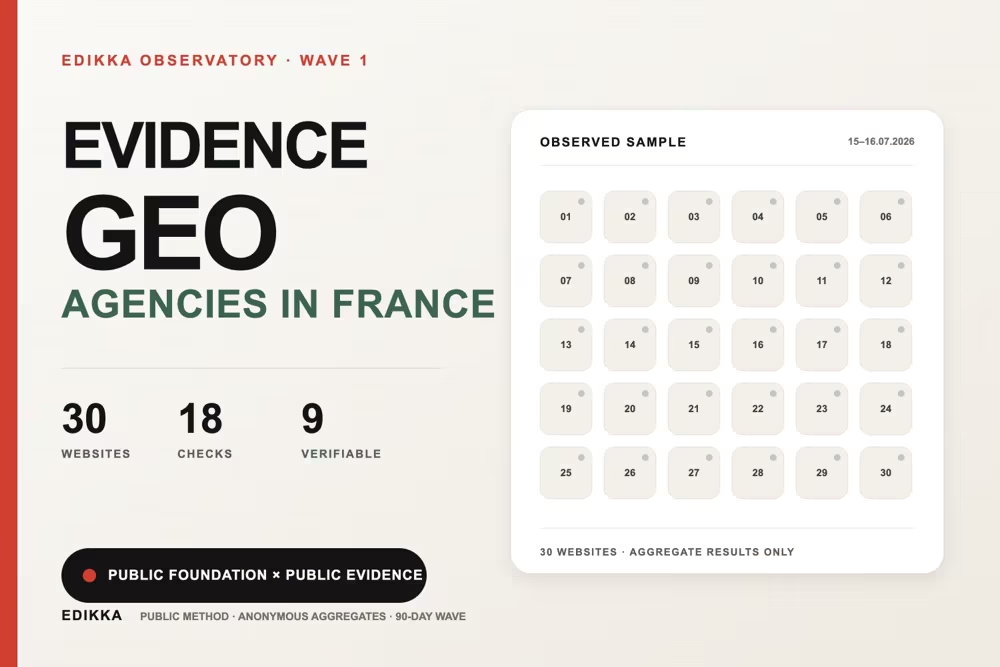
SEO Advanced 9 out of 30 websites publish GEO evidence that a third party can ...

SEO Advanced GPTBot, Google-Extended, ClaudeBot, Applebot-Extended, Perplexity: a ...

SEO Advanced After GEO citability, the next challenge is actionability: helping AI ...

SEO Understand The Edikka GEO Readiness Index uses public, verifiable signals to ...